Tuesday, July 24, 2012

Greens Aerification

Aerification

It’s that time of the year once again, we get out those dreaded machines that “mess up the greens” and start our aerification practices. Please realize that aerification is for the long term health of the turf and will ultimately promote a healthier green. 

“Aerification (also known as aeration) achieves three important objectives. It relieves soil compaction, it provides a method to improve the soil mixture around the highest part of a green’s roots and it reduces or prevents the accumulation of excess thatch.

Like so many things, the quality of a good putting green is more than skin deep. In fact, the condition of a green has a lot to do with what goes on below the surface. In order for grass to grow at 1/8-inch, it must have deep, healthy roots. Good roots demand oxygen. In good soil, they get the oxygen from tiny pockets of air trapped between soil and sand particles.

Over time, the traffic from golfer’s feet (as well as mowing equipment) tends to compact the soil under the putting green – particularly when the soil contains a lot of clay. When soil becomes compacted, the air pockets on which the roots depend are crushed, and the roots are essentially left gasping for air. Without oxygen, the grass plants become weaker and will eventually wither and die.

Aerification is a mechanical process that creates more air space in the soil and promotes deeper rooting, thus helping the grass plants stay healthy. In most cases, it’s done by removing half-inch cores (those plugs you sometimes see near a green or in fairways) from the compacted soil, allowing for an infusion of air and water that brings a resurgence of growth. The spaces are then filled with sand “topdressing” that helps the soil retain air space and makes it easier for roots to grow downward.

Older greens often are constructed of soils with significant amounts of silt, clay and fine organic particles that are prone to compaction. Filling aerification holes with sand improves drainage and resists compaction. The periodic introduction of sand to a green’s top layer can, over time, avoid or postpone expensive rebuilding or renovation of greens.

Finally, growing of turf adds to a layer of organic matter on the surface. This layer, called thatch, is an accumulation of dead stems, leaves and roots. A little organic matter makes for a resilient green, but too much invites diseases and insects. Topdressing with sand can prevent thatch buildup, and aerification is one of the best ways to reduce an existing layer and prevent an excess of thatch from becoming established.”

For several days after the aerification, the greens will not be as smooth as desired and the patience of all golfers will be tried to a certain extent. But rest assured, the greens will quickly return to a normal, smooth putting surface and will be all the healthier for the effort.

Tuesday, July 17, 2012

Test Bunker

Test Bunker at White Wing Short Game Area

In an effort to increase the firmness of the greenside bunkers we have taken some sand out of one of the greenside bunkers at the White Wing Short Game area and mixed in a different type of sand. The bunker has been marked with signs and we will evaluate it over the next few weeks to see if we are getting the desired results. This was only done a few days ago so we will need to wait a week or two to let the new sand get mixed in good enough for evaluation. Once we establish that it has worked we will then continue this process out on the course.

July Course Condition Update

Course Conditions July 2012

Over the past month we have been able to get the fairways at all three golf courses aerified. We will try and get one more core aerification done this season on the fairways in conjunction with slicing the roughs in the high traffic areas. The tees have also been done at White Wing and Cowan and Legacy is scheduled for next week.

We have taken out the Sure Play sand in one of the bunkers at the White Wing short game area and mixed in some Caylor White sand so we can use this as a test bunker before moving ahead with the rest of the greenside bunkers on the course. We have marked it with a “Test Bunker” sign and look to get feed back from the Golf Committee members as well as the Playability Sub-Committee members. 

The last of the large core tine aerifications are going to be done within the next few weeks with the exception of Cowan Creek which will have one more additional ¼” core tine aerification before fall. The remainder of the aerifications will be solid tine aerifications with minimal disturbance.

We have been getting areas of the fairways and green surrounds that have been getting too wet due to us trying to keep other areas from getting dry. We are making head adjustments and switching out to different types of heads around the greens to keep the approaches and perimeters dryer to avoid any plugged shots or equipment damage. This is a bigger problem at Legacy Hills due to the design and age of the system so we have started there first.

Tuesday, July 3, 2012

Cowan Creek Drainage Update

Continued Drainage Issues – Cowan Creek (2012)
Prepared By: Craig Loving
Cowan Creek Golf Club, Superintendent

            As you may know, there are still some areas that are struggling on the greens at Cowan Creek.  The issue was most prominent earlier this year on #6 green. We discovered that the drainage leaving the left side of the green was cut in order to allow room for the irrigation lines, but the drainage was never redirected or fixed.  The pipe was buried with dirt and sand, which ultimately clogged both ends of the cut pipe making the drainage in that area of the green useless.  We have since repaired the drainage and re-sodded the weak areas on the green, and it has recovered well.  The following paragraphs will discuss additional problems we are encountering regarding improper drainage, and how we plan to address them.  

            The left side of #9 green has been a concern for us coming out of dormancy in prior years, but it has bounced back in the past with additional aggressive cultural practices.  We use techniques such as weekly solid tine aerifications to allow air and water infiltration into the upper rootzone.  The left side of #9, bottom right side of #7, and the middle of #13 green were all troubled areas last year that we recovered from using these practices.  Unfortunately, this year we aren’t seeing as much of a positive response.  As you know, there are many areas that we continually hand spike and topdress with sand in order to provide a healthier medium for the grass on the surface to grow laterally and fill in.  Most of these areas have improved or are improving, but some have shown no response, even with the warmer temperatures and extra attention we give them.  All of this can be attributed to improper drainage, and a lack of oxygen in the rootzone.

            On Tuesday (6/26/12) we invited David Doherty, the CEO and founder of ISTRC (International Sports Turf Research Center), to give a seminar on the physical properties beneath the surface of golf course greens.  We have used ISTRC’s services in the past to run tests on core samples from our greens.  They tested infiltration rate, air porosity, bulk density, water holding capability, organic content, etc. on plugs from each course.  After analyzing the results, they gave us recommendations for future aerifications and other cultural practices to help us reach optimum conditions for growing and maintaining healthy turf.  The seminar touched on this, along with methods of introducing air into the rootzone using existing drainage pipe.  In addition to attacking our problems from the surface down, he explained ways to promote healthy turf from the bottom up.

            After the seminar, we had David come with us to #9 green so we could get his input on our situation there.  Using a witching stick, he marked where he thought the drainage pipe was located on the green so we could narrow down where to attack the problem.  We believed that if we could access the pipe, we would be able to identify where the drainage was failing.  The following day we dug into the areas marked by Dave beneath the sand base and the gravel layer, in hopes to find where the drainage channels were located to access the pipe.  Needless to say, none of the holes were atop a drainage channel, so we patched them up and went with a more drastic approach.  By digging a trench inside the green, we were able to locate one of the drainage pipes.  We now know that there actually was pipe installed, and this will serve as a starting point for us to address the problem and improve the drainage on this particular green.
As of right now, we are still looking for all of the existing pipe on #9,  and once we have the drainage completely mapped out, we will be able to fix the improperly installed pipe.  We have the area roped off, and the pin placements on the green will remain on the right side until the left side is once again playable. Upon completion, we will move onto #7 and #13.  We appreciate your patience.

Monday, June 25, 2012

Course Conditions Update June 2012

Course Conditions June 2012
The Cowan Creek greens were obviously the big topic of discussion the first quarter of the year due to poor putting quality and appearance. They are rolling smoother and faster now but we still are not satisfied with the overall health and aesthetics of the greens, we will continue working our plan and following the USGA’s recommendations until they are completely healed.

Greens aerifications have been going well with the exception of mechanical/operator problems that left some tire marks on various greens. These areas have been topdressed and smoothed back out and are healing up well. We will modify our clean up process in the future to eliminate this problem. In regards to greens aerifications I have received some emails in regards to the amount of times we aerify. I have attached a comparison of last years schedule in this weeks Golf Communicator to show that nothing has changed from previous years with the exception of the additional Cowan Creek aerifications to address our organic matter problem.

We have begun our fairway aerifications and will try to complete two core aerifications on each course over the next three months and one solid slicing aerification after that. This also includes aerifying high traffic areas in the roughs and tee boxes.

Tree trimming at Legacy Hills was completed this month and it has made a dramatic change in both appearance and playability. This has been on the playability report list for two years and was a big item to get knocked off the list. The smaller tree limbs will be done in house by December of this year. We also have numerous dead trees and shrubs on the course that will need to be taken out when time allows this winter.


White Wing and Legacy Hills Bunker Summary

The White Wing and Legacy Hills Greenside Bunkers have been one of our weakest areas in terms of playability. This issue has had us trying many different methods to speed up the firming process. 

Actions that have been taken:
  • Sprayed sand traps with wetting agents
  • Hand watered when staff was available to do so
  • Used hand tampers to try and pack the sand
  • Lab Tested sand to verify proper specifications – It did meet the guidelines.
  • Contacted the Sand Supplier for any recommendations on firming the bunkers up more quickly.
  • Contacted several Superintendents in the State that have used the same sand and compared notes on the maintenance of the bunkers.
  • Removed 2 inches of sand from the greenside bunkers on #18 at LH and #16 greenside at WW to see if the shallow depth would help the sand set better. We are going to give it two weeks from June 25th and evaluate it then.

Future Actions to be taken:
  • Evaluate the bunkers that we removed the sand from
  • If it is still soft we will have to remove an inch or two out of the greenside bunkers and add in sand that will compact more. It will be the same color but will be a different particle size and more angular in shape so that it will compact.

What will be done?
It is most likely we will have to remove an inch or two out of the greenside bunkers and add in sand that will compact more. It will be the same color but will be a different particle size and more angular in shape so that it will compact.

When will this all be done?
Going forward from today we will be re-training the staff to rake the sand down from the sides and then remove the excess from the bottoms. Once this is complete we will use the new sand and blend it in with what we have. Due to our staff size this is not something that can happen over night, we will have to continually work on this and have it completed sometime in the winter or early spring. We will continually test the traps and also ask for feedback from our playability committee on the firmness a playability of the bunkers as we work through this problem. 

Monday, June 18, 2012

Fairway Aerifications Have Begun

We have begun our fairway aerifications and will try to complete two core aerifications on each course over the next three months and one additional solid slicing aerification after that. This also includes aerifying high traffic areas in the roughs and tee boxes. After we have cleaned up the cores the holes should be healed over in just a few days. Don't forget that if your ball comes to rest in an aerification hole you can take free relief from the aerification hole no closer to the pin.


Wednesday, June 13, 2012

Golf Course Update (We are making progress!)

Golf Course Update
Cowan Creek Greens Update
Progress is being made! The greens at Cowan are starting to roll much smoother and the health of the turf is coming back. We still have the low areas to work on, but, with continued aerifications of these areas, we will win the battle. These photos are the before and after pictures of the soil profile of the lower left area on #9 green. As you can see, with just 3 aerifications, we have significantly reduced the amount of Black Layer and provided many channels to let the roots get oxygen, thus producing a healthier plant.


Sand Traps at White Wing and Legacy Hills
With input from the Course Playability Committee and Golf Committee, we are going to be removing some sand out of a couple of select greenside bunkers, to see if it will help with the firmness of the sand. This will be completed and reviewed before the next Golf Committee meeting on June 25, so that we can report our findings back to the Committees at that time. This may or may not be a solution, but, unless this option is explored, we do not know the answer. We are also sending sand samples into a lab to review the specifications of it; this will determine if it matches the specifications that were given to us at the time of construction. This will also let us know if we are dealing with sand that meets the USGA recommended specifications.

Thursday, June 7, 2012

White Wing Driving Range Mat Modification

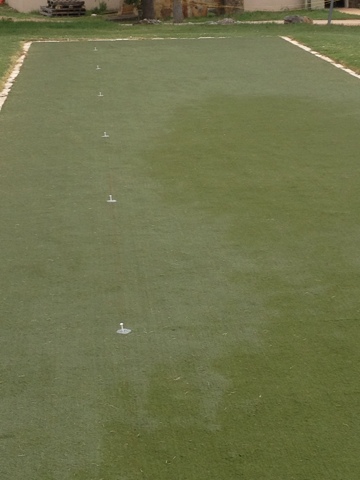
The next time you are assigned to hit off of the Mats at White Wing you notice something new. We drilled holes in the mat and marked these areas with a white circle. If you place a golf tee in the center of this circle you will find a hole where your golf tee can go into the ground beneath the mat. We have done this so that it will make it easier to hit Drivers from the mat area and eliminate the need to step off the front of the mats to the grass area of the tee. This will not only make it safer but it will also allow the turf time to recover in those areas.

Friday, June 1, 2012

Tree Trimming @ Legacy Hills

Anyone playing Legacy Hills today may notice some trees that have been tagged with construction ribbon. These trees have been marked so that the tree company can identify what we have had bid for trimming. This will just be trim work NOT removal.

Thursday, May 31, 2012

Golf Course Maintenace Update

**Golf Course Maintenance Update**

Greens aerification will take place at Legacy Hills on Monday June 4th. This will be the same method we have used in previous weeks at both White Wing and Cowan Creek.


Aerification “Why do we do it?”

It may seem that every time we get the greens “perfect” we go out and punch thousands of holes in them again. Unfortunately aerification is a necessary evil when it comes to the care of any golf green. The condition of the greens has a lot to do with what goes on beneath the surface of the grass. Roots need oxygen; they usually get this from tiny pockets of air trapped between sand and soil particles. Over time, foot traffic and mowing equipment compact the soil thus eliminating these pockets and depriving the roots of oxygen. This is where aerification comes in; by removing cores it promotes deeper rooting and more air space which in turn helps the plant stay healthy. Normally through out the growing season we will do anywhere from 4 to 6 aerifications with varying size tines ranging from ¼” to ¾” in diameter and at different depths depending where the organic matter and compaction zones are. The end result after healing is a much healthier plant with a better growing environment.