Monday, May 14, 2012

Course Condition Update

Course Conditions Update

We received our report back from the USGA and have already implemented most of their recommendations. This means more aerifications for Cowan Creek to address the organic matter build up and to remedy our sodium problems by flushing post aerification. Last week after the deep tine aerification and flushing we have already noticed a difference. With continued cultural practices they will steadily improve.

We hosted the Support the Troops tournament at White Wing on Thursday of last week and besides a little rain it went very well. Being a veteran myself I love to see that our community here is so supportive of our service people. Thank you.

The greens at White Wing are coming in very nicely and with the exception of #1 green they are doing great. We will start plugging out bad spots on #1 this week so that we can get that green up to par with the rest of the greens on the course.

On a side note we had a lightning strike on #18 at White Wing on Thursday night after the storms had come through.


The strike caused all of the irrigation control boxes on #18 to shut off and the trip the breaker located at the shop. We will have to go through this week and test each sprinkler to make sure they are working properly, many times lightning strikes “fry” the solenoids and we have to dig up the heads to repair them.

Don’t forget to check out the golf maintenance Blog!

Wednesday, May 9, 2012

Additional Rolling at Cowan Creek

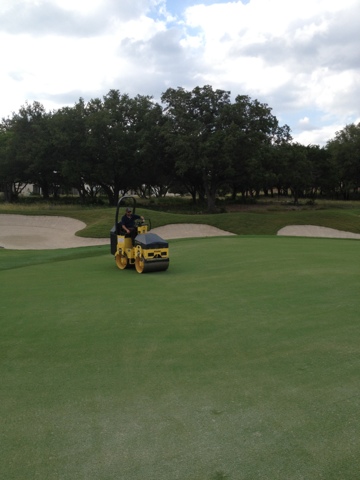
With the aggressive aerification at Cowan Creek on Monday we rented a 1.5 Ton roller to expedite the smoothness returning to the putting surfaces. Before rolling today we measured the the greens with the stimp meter and they were at a 7.5, after rolling they measured at a 9. We will do this one more time and then use our rollers the rest of the week to improve on this.

Tuesday, May 8, 2012

The Greens Flushing at Cowan Creek

You can see from the attached video that we were successful with flushing the greens at Cowan Creek.
This process should have a very positive impact on removing sodium from our soil profile.

Monday, May 7, 2012

Cowan Creek Greens Aerification

Just wanted to let everyone know that although the Cowan Greens are responding well to our cultural practices and the warmer weather we still have a ways to go. It may seem from the outward appearance that they are getting better and finally starting to get healthy again but underneath the surface we still have organic matter build-up and sodium issues to deal with. Today we are doing a deep tine aerification with a 13/16" coring tine at a depth of 7 1/2". This may seem to be taking a step back as far as ball roll and smoothness are concerned but it is a necessity that it be done for the future health and benefit of the greens. We hope to have them healed up and smooth again within the next two weeks.

Thursday, May 3, 2012

Don't mess with the Golf Pros!

Last month a few of us from the Golf maintenance department decided to challenge your Sun City Head Golf Professionals to a round of golf. As you can see from the photo it did not work out in our favor. Turns out the Pros are pros for a reason and the wager was the losers had to wear Pink Sparkle hats to our monthly CA safety meeting. Let me tell you, we were a big hit!


Tuesday, May 1, 2012

Cowan Creek Drainage Issue #6 Green


Cowan Creek Drainage Issue - #6 Green

Since the grow-in at Cowan Creek, some of the greens have out-performed others under the stress they receive, and are generally easier to maintain. #6 green was a prime example of one of the greens that rarely had any problems in years past. However, when we came out of dormancy, it was a surprise to see that it was in the worst condition in relation to the other greens. We found out that in addition to the current problems we are facing on all our greens, #6 green wasn’t draining properly. There are two drainage outlets that leave this green, one in the low area on the left side of the green, the other in the front of the green. Both metal drainage basins are located in the green surround on the left side of the hole. Using a plumbing snake, a hose, and a wire locator, we found that there was a problem with the drainage pipe somewhere in between the exit of the green and the drainage basin. We dug it up, and here’s what we found:
The first problem we found was that the pipe had been crushed during or after installation. This is what we originally thought was the problem, so we dug this area up so we could replace the crushed pipe with new pipe.


After digging it up, we discovered 4 feet of crushed pipe which was completely filled with mud and rocks, and the upper end of the pipe was cut and exposed, not connected to anything.

We continued digging closer to the green to find that the pipe was cut in two places to allow room for an irrigation line. The picture below shows where the drainage pipe was cut on the high side of the drainage line, and the irrigation pipe running through where the drainage pipe should be:

With only one properly working drainage outlet, this issue could play a large role in having anaerobic conditions on this and other greens. We have fixed the drainage problem in this area, and we will continuously check other problem areas to see if cutting drainage pipe was a popular practice during course construction.

Friday, April 27, 2012

USGA Agronomist Site Visit Summary

USGA Green Section Site Visit – Cowan Creek

On Thursday (4/26/12) we invited Bud White (an agronomist from the USGA Green Section staff) out to Cowan Creek to take a look at our greens and discuss some of the issues we are dealing with. Below will be a brief summary of his conclusions, and solutions to our current issues:

There are two problems currently within the soil profile that were brought to our attention. The first of which pertains to what Mr. White called a “hard pan” layer in the greens mix about 6” deep in the soil profile where finer sands have accumulated over time, prohibiting water infiltration. A proper greens mix has a precise distribution of sands with varying particle size to allow room for air and water movement through the rootzone and soil profile. He suggested that we take two samples to be sent off and analyzed to determine if we have the correct sand mix for our greens. The samples will be used to test particle size, soil texture, organic matter, and water infiltration rates. On 4/27/12, we took one sample from the back of #17 green to represent a healthy stand of turf with proper drainage, and another sample from the left side of #9 green where we have been having drainage issues and turf quality problems.

The second issue involved a sodium buildup in the rootzone, where a black layer has formed. By using digital meters that measure total salts and sodium in the soil, we found that our sodium levels were higher than the accepted number for healthy turf. The origin of these unwanted salts comes from our irrigation water, which is effluent or “treated” water. Sodium molecules when absorbed by the roots prohibits water and nutrient uptake in the plant and can cause the plant to yellow, wilt, and eventually die if not treated. Mr. White suggested that we amend this issue by fertilizing with gypsum and flush the salts with water, which I will explain below.

Overall, with our current cultural practices to allow air and water to the roots and our fertilizer program, along with two of the recommendations from Mr. White, we should see improvement in the turf quality as we progress into the growing season. Many of our practices were validated, and we received supplemental insight on how to achieve a faster recovery from the spring transition.

“Hard Pan” Solution

Without proper drainage, greens more readily can seal off at the surface and create anaerobic conditions in the rootzone that cause these areas to become weak and bare. A deep tine aerification has been scheduled on 4/7/12 to penetrate through this hard pan to allow air and water movement through the entire soil profile. We will be using a hollow tine with a 13/16” outer width that will punch close to a .5” hole 10” deep into the soil profile. We will then add fertilizer amendments and topdress with greens-grade sand. Afterwards, we will verticut the greens at 1/8” depth to help close up the holes on the surface.


Sodium Flush

During our deep tine aerification, we will add gypsum (CaSO4) at a rate of 11 lbs / 1000 sq. feet to break off the sodium on the roots, and then flush the greens with very large quantities of water. This process is recommended in order to properly buffer the salts in the rootzone, and requires us to water every green constantly for up to 90 minutes. This will undoubtedly leave the greens surrounds and approaches wet for 2-3 days, but is a necessity for proper salt flushing. Afterwards, we will follow up the flush with potassium and magnesium amendments.

Wednesday, April 25, 2012

Legacy Hills "Why is the course so dry?"

Over the past few days we have had mechanical problems with the pump station at Legacy Hills which caused it to be shut down. It had already been operating with one pump down because we have been waiting for the New #1 pump to be delivered and installed. With a second pump going down it limits us on the amount of water we can put out in gallons per minute. This causes the water window (time at night that we can water the course) to be longer and drawn out. That being said we do have half of the station back up and running and will be putting more water out on the course as of today.

Tuesday, April 24, 2012

April 24th Course Updates

* #6 Green at Cowan Creek
The sod on #6 has started to put down roots and is taking well. We will evaluate it early next week and decide if we will open it on May 1st or delay the opening of that green. Our hopes were that it would be ready sooner but with average temperatures still in the 130's we are still not at optimal growing weather for bermuda grass greens.

* Cowan Greens
With warmer temperatures in the forecast things at Cowan in regards to the greens should start to improve. The most recent problem we have experienced with the Cowan greens has been the surfacing of another under lying problem. The greens on the areas where they are not draining well have became Anaerobic, which means they are sealed off and have no oxygen to the plant or it's roots. We have started aerifying these areas so that we can provide air and oxygen to those areas.

* USGA
On Thursday April 26th we will have the Southern USGA rep at Cowan to do a Turf Analysis report of Cowan's greens and course conditions. We look forward to this outside source to give us insight and recommendations on our current practices at Cowan.

* White Wing Aerification
Monday we aerified the greens at White Wing and everything went well. With us only pulling a 3/8" core they should be fully healed in two weeks.

* Legacy Hills
We will be performing the same aerification as White Wing at Legacy Hills on Monday April 30th. Recently we have noticed areas on the Legacy greens that have been off color, we sent in soil samples and it showed a severity of 3 out of 5 for Bermuda Grass Decline. We have treated for it and have seen a positive response and green up of the turf.

*Attached Picture
The picture below shows a plug from an Anaerobic area of #9 green at Cowan Creek. If you notice the top three inches is dark black were it is "sealed" off. The entire profile should look like the bottom half of this soil profile. With aerification and water management we will be able to remedy this problem.


Monday, April 23, 2012

Cowan Creek Update

Thursday morning we will have a representative from the USGA at Cowan Creek to do a course evaluation and tour and report back his findings to the Golf Committee and CA staff. We look forward to his insight and recommendations.